We’re Embacy, an international design studio, and we’ve started this project in search of visual language
and symbols that could express these shared values.
and symbols that could express these shared values.
This is not a political article. It’s not scientific research. These are just some of the expressions of peace
that may keep you hopeful without having to bury your head in the sand. There was always anger, conflict,
misery; yet, it was always opposed by the striving for a better world.
that may keep you hopeful without having to bury your head in the sand. There was always anger, conflict,
misery; yet, it was always opposed by the striving for a better world.
We live in turbulent, unprecedented times — which is something that could be said at nearly every point
of humanity’s existence. As everlasting as the strife and conflict may be, so is the human desire for
peace. Peace is something necessary to us, sacred even, and we all express it in a variety of ways — from
doves and olive branches to finger V and broken rifles. In spite all, hope springs eternal.
of humanity’s existence. As everlasting as the strife and conflict may be, so is the human desire for
peace. Peace is something necessary to us, sacred even, and we all express it in a variety of ways — from
doves and olive branches to finger V and broken rifles. In spite all, hope springs eternal.
The Visual Language of Staying Hopeful
— Special Project by Embacy
10 Ways We
See Peace
See Peace
The Visual Language of Staying Hopeful
— Special Project by Embacy
10 Ways We
See Peace
See Peace
10 Ways















Olive
Branch
Branch
Olive
Branch
Branch
As Poseidon struck his trident to claim the ownership of Attica, Athena responded by planting an oil tree. The olive tree became a sign of prosperity and abundance.
As Poseidon struck his trident to claim the ownership of Attica, Athena responded by planting an oil tree. The olive tree became a sign of prosperity and abundance.
Ancient Greece
Ancient Greece
Vase Painting, Ancient Greece
With its succession, the olive branch was also commonplace in ancient Roman culture. There are
records of defeated generals extending an olive branch after defeat, as well as olive branches
being a common motif on coins. In Roman mythology, it was one of the symbols of the goddess
Pax (Latin for peace) as well as that of the lesser-known aspect of Mars, Mars the bringer of Peace.
records of defeated generals extending an olive branch after defeat, as well as olive branches
being a common motif on coins. In Roman mythology, it was one of the symbols of the goddess
Pax (Latin for peace) as well as that of the lesser-known aspect of Mars, Mars the bringer of Peace.
With its succession, the olive branch was also commonplace in ancient Roman culture. There are
records of defeated generals extending an olive branch after defeat, as well as olive branches
being a common motif on coins. In Roman mythology, it was one of the symbols of the goddess
Pax (Latin for peace) as well as that of the lesser-known aspect of Mars, Mars the bringer of Peace.
records of defeated generals extending an olive branch after defeat, as well as olive branches
being a common motif on coins. In Roman mythology, it was one of the symbols of the goddess
Pax (Latin for peace) as well as that of the lesser-known aspect of Mars, Mars the bringer of Peace.
Today the olive branch unequivocally means peace and is often used in the flags and logos of
organizations striving for peace.
organizations striving for peace.
Today the olive branch unequivocally means peace and is often used in the flags and logos of
organizations striving for peace.
organizations striving for peace.
Ancient Rome
Ancient Rome
Today
Today
Ancient roman coin
Portrait of Queen Elizabeth, Marcus Gheeraerts
Pallas and the Centaur, Sandro Botticelli


Olympic
Truce
Truce
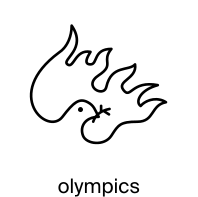
The winners of the ancient Olympic Games were crowned with wreaths of wild olive trees. During the games, the Olympic Truce (ekecheiria) was observed — in time of warring city-states, this celebration of life and athleticism was sacred.
Northern and southern koreans marching together at 2000 olympics
Northern and southern koreans marching together at 2000 olympics
Logo of the olympic truce
Dove
Dove
I stand for peace against war.
I stand for peace against war.
I stand for life against death;
I stand for life against death;
— Pablo Picasso, 1950, Peace Congress in Sheffield
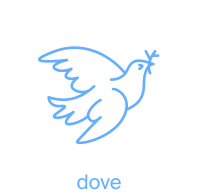
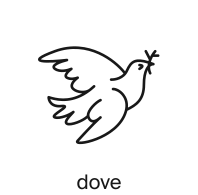
As ubiquitous of a symbol as the olive trees, we’ve come to see doves as an embodiment of peace. Pure
and innocent creatures that symbolize everything that is life — the sacred symbol of Aphrodite is often let
out to flutter at weddings. Kamadeva, the god of love in Hindu mythology, is often depicted riding a dove.
and innocent creatures that symbolize everything that is life — the sacred symbol of Aphrodite is often let
out to flutter at weddings. Kamadeva, the god of love in Hindu mythology, is often depicted riding a dove.
As ubiquitous of a symbol as the olive trees, we’ve come to see doves as an embodiment of peace. Pure
and innocent creatures that symbolize everything that is life — the sacred symbol of Aphrodite is often let
out to flutter at weddings. Kamadeva, the god of love in Hindu mythology, is often depicted riding a dove.
and innocent creatures that symbolize everything that is life — the sacred symbol of Aphrodite is often let
out to flutter at weddings. Kamadeva, the god of love in Hindu mythology, is often depicted riding a dove.
In Genesis, the dove appears to Noah after the flood as the harbinger of peace, and in the New
Testament dove represents Holy Spirit.
Testament dove represents Holy Spirit.
In Genesis, the dove appears to Noah after the flood as the harbinger of peace, and in the New
Testament dove represents Holy Spirit.
Testament dove represents Holy Spirit.
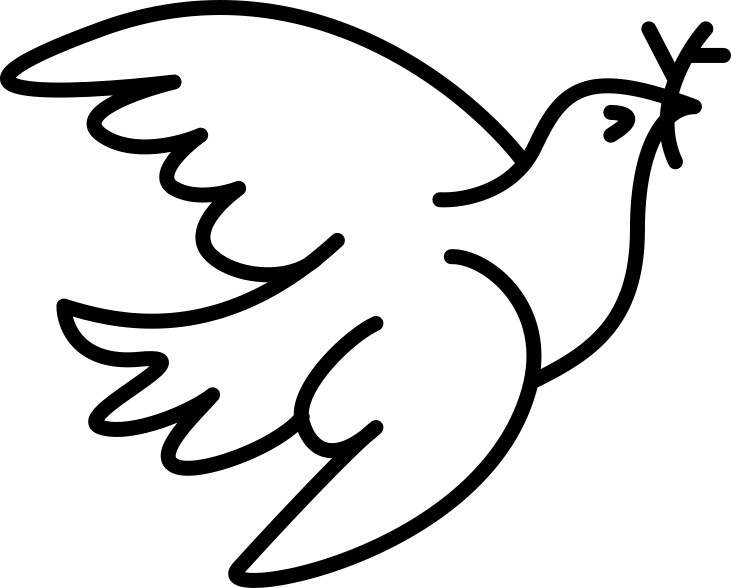
Pablo Picasso’s Dove was chosen as the symbol for the World Peace Congress in 1949. His father bred
pigeons (rock doves) and had taught young Pablo how to draw them. Since then, birds appeared
throughout his body of work, from Child with a Dove, 1901 all the way to The Pigeons, 1957. The peace
dove and The Pigeons were both inspired by Matisse and his exotic pigeons, and Picasso’s fourth child
was named Paloma (Spanish for dove).
pigeons (rock doves) and had taught young Pablo how to draw them. Since then, birds appeared
throughout his body of work, from Child with a Dove, 1901 all the way to The Pigeons, 1957. The peace
dove and The Pigeons were both inspired by Matisse and his exotic pigeons, and Picasso’s fourth child
was named Paloma (Spanish for dove).
Pablo Picasso’s Dove was chosen as the symbol for the World Peace Congress in 1949. His father bred
pigeons (rock doves) and had taught young Pablo how to draw them. Since then, birds appeared
throughout his body of work, from Child with a Dove, 1901 all the way to The Pigeons, 1957. The peace
dove and The Pigeons were both inspired by Matisse and his exotic pigeons, and Picasso’s fourth child
was named Paloma (Spanish for dove).
pigeons (rock doves) and had taught young Pablo how to draw them. Since then, birds appeared
throughout his body of work, from Child with a Dove, 1901 all the way to The Pigeons, 1957. The peace
dove and The Pigeons were both inspired by Matisse and his exotic pigeons, and Picasso’s fourth child
was named Paloma (Spanish for dove).
Blue Dove of Peace, 1950s
La Colombe, 1961
Henri Matisse, 1947
Dove of Peace, 1949

Hiroshima and
Nagasaki
Nagasaki
Hiroshima and
Nagasaki
Nagasaki
A clock from Hiroshima stopped at 08:15 AM
Hiroshima Peace Memorial Park
Hiroshima mon Amour, movie posters
Peace Memorial Ceremonies are held annually at Hiroshima and Nagasaki, on August 6th and 9th respectively. Both culminate with the release of doves.
The bombings of Hiroshima and Nagasaki stand out as some of the most heinous singular acts of the bloody 20th century. The Nagasaki Atomic Bomb museum invites us to stroll through the remnants of past Japan militarism followed by the horrific consequences of military actions. The exhibition ends with appeals for the abolition of nuclear armaments.
Hiroshima mon amour (1959) shows how we deal with events such as these. Shot mere 14 years after the war, it portrays a French actress arriving at Hiroshima to shoot an anti-war movie, and her brief affair with a Japanese man. One of the most significant post-war movies, it shows time shattered, and the difficulty of trying to comprehend and deal with the unthinkable atrocities that we live with. The passage of time and eventual closure and/or numbness feels like a betrayal — yet, it is inevitable.
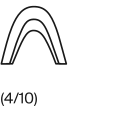
Presented with no commentary.
Posters
Presented with no commentary.
Posters


Christmas
Truce
Truce
Truce
Even amid cruelty, we seek humanity in fellow men. While no official ceasefire was issued, on Christmas Eve
1914, British and German soldiers began singing carols to each other over the trenches.
1914, British and German soldiers began singing carols to each other over the trenches.
On Christmas day itself. German soldiers walked through the barbed-wired “no man’s land” unarmed. When the
British realized this wasn’t a trick, they came out of the trenches as well. Hands were shaken, cigarettes
exchanged, songs sang. The celebration peaked with a game of soccer.
British realized this wasn’t a trick, they came out of the trenches as well. Hands were shaken, cigarettes
exchanged, songs sang. The celebration peaked with a game of soccer.
Eventually the English brought a soccer ball from their trenches, and pretty soon a
lively game ensued. How marvelously wonderful, yet how strange it was. The
English officers felt the same way about it. Thus Christmas, the celebration of Love,
managed to bring mortal enemies together as friends for a time.
lively game ensued. How marvelously wonderful, yet how strange it was. The
English officers felt the same way about it. Thus Christmas, the celebration of Love,
managed to bring mortal enemies together as friends for a time.
— German Lieutenant Kurt Zehmisch of the 134 Saxons Infantry
In 2014, on the 100th anniversary of the truce, the English and German national soccer teams staged a friendly
match (England won).
match (England won).

A German and British Soldier Share a Cigarette During The Christmas Truce of 1914
Guernica, 1937
Picasso’s Guernica, with its subdued tones and deliberate matte finish, stands 11 feet tall and 25 feet across,
and looms over the viewer with its captivating vision of suffering. Following the German bombing of the Spanish
town of Guernica, all Picasso could do is read about it in the papers. Read and paint.
and looms over the viewer with its captivating vision of suffering. Following the German bombing of the Spanish
town of Guernica, all Picasso could do is read about it in the papers. Read and paint.
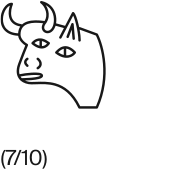

Picasso had decided that the mural would come to his homeland of Spain only after the country would become democratic and have free elections. He did not live to see his wish — the first democratic election of Spain was held in 1977, while Picasso died in 1973.
The resulting artwork is frenetic and fractured, full of agony in every direction; screams, flames, death. Yet, at the center of the piece is a small dove, next to the light shining through. There’s still hope.
Unknown author, 1970s, Stop the War in Vietnam Now!
C. Elle, People Protesting Using Guernica details
Today, Guernica remains a powerful anti-war symbol. The parts of the artwork were brandished during the protests against the Vietnam war, the Iraq war, the Afghanistan war, and more.
Flower
Power
Power
“[...] exemplary spectacle...
outside the war psychology”
outside the war psychology”
— Allen Ginsberg, 1965
March on the Pentagon, October 21, 1967
While sanitized and dismissed over the years, the hippie movement grew out of common and popular sentiment: the war in Vietnam must stop. Preceded by such towering figures as Mahatma Gandhi and Martin Luther King, the hippies stared in the face of viciousness and opposed it with non-violet methods.
March on the Pentagon, October 21, 1967, Marc Riboud
In 1967, over a hundred thousand people — hippies, activists, and regular office workers alike — marched to peacefully protest against the war. This protest resulted in the iconic imagery of guns being disarmed with flowers.

Peace
Sign
Sign
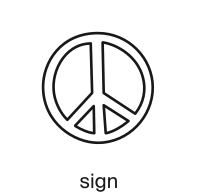
The common peace sign, which is now firmly associated with hippies as well, means more than the generic
doves and branches. Nuclear disarmament remains relevant as long as nuclear weapons exist.
doves and branches. Nuclear disarmament remains relevant as long as nuclear weapons exist.
In 1958, Gerald Holtom designed this sign as a logo for British Campaign for Nuclear Disarmament. The sign
consists of semaphore signals for N and D superimposed on one another, standing for Nuclear Disarmament.
consists of semaphore signals for N and D superimposed on one another, standing for Nuclear Disarmament.
Sketch of Nuclear Disarmament Symbol by Gerald Holtom, 1958
The Third of May 1808, Francisco de Goya, 1814
“I was in despair. Deep despair. I drew myself: the representative of an
individual in despair, with hands palm outstretched outwards and
downwards in the manner of Goya’s peasant before the firing squad”
individual in despair, with hands palm outstretched outwards and
downwards in the manner of Goya’s peasant before the firing squad”
Later, Holtom had said that he wished that the widespread version of the symbol would be inverted — to
celebrate peace, rather than brace yourself for despair.
celebrate peace, rather than brace yourself for despair.
Haight Street, Jim Marshall, 1960s

We kind of heard that a few of the East Berliners might actually get the
chance to hear the thing, but we didn’t realize in what numbers they
would. And there were thousands on the other side that had come close to
the wall. So it was like a double concert where the wall was the division.
And we would hear them cheering and singing along from the other side.
God, even now I get choked up. It was breaking my heart. I’d never done
anything like that in my life, and I guess I never will again.
chance to hear the thing, but we didn’t realize in what numbers they
would. And there were thousands on the other side that had come close to
the wall. So it was like a double concert where the wall was the division.
And we would hear them cheering and singing along from the other side.
God, even now I get choked up. It was breaking my heart. I’d never done
anything like that in my life, and I guess I never will again.
In 1987, just two years before the fall of the wall, David Bowie had performed in West Berlin close enough to the border that many Eastern Berliners heard the show and sang along.
David Bowie Sing 'Heroes' at the Berlin Wall in 1987
Thousands of East Germans listened to David Bowie perform on the other side of the Berlin Wall in June 1987
Songs
of Peace
of Peace
Despite the bleak and self-defeating lyrics, we see Heroes as an anthem of peace and freedom. If just for one day. From Imagine and Give Peace a Chance to 2 Minutes to Midnight and War (What Is It Good For?), from All Along The Watchtower and Holiday In Cambodia to Bulls on Parade and Killing In The Name, to B.O.B. and B.Y.O.B, there’s so much music devoted to keeping the world together, rather than apart. It’s probably the most common theme for a song (after love). All everyone wants is clear blue sky.
— Bowie said of the performance
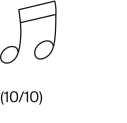
Bulls on Parade
Rage Against the Machine, 1996
System of a down, 2005
B.Y.O.B
Rage Against the Machine, 1991
killing in the name
Heroes
David Bowie, 1977
John Lennon, 1971
Imagine
2 Minutes To Midnight
Iron Maiden, 1971
holiday in cambodia
dead kennedys, 1979
Pink Floyd, 1979
The wall
Jimi Hendrix, 1968
All along the watchtower
You know we’ve got to find a way
To bring some loving here today
For only love can conquer hate
We leave you now with Marvin Gaye’s What’s Going On:
This is non-profit, educational material.
All copyrights are reserved to their respective owners.
All copyrights are reserved to their respective owners.
Agency
About us
Culture
Stories
Showreel
Services
Branding
Web Design
Webflow
All services
Subscribe to keep in touch
Enter your email
Subscribe
hello@embacy.io
